Can I Do a Diploma Course Online in the UK?
Yes. Many diploma courses can be studied online in the UK, although whether a qualification can be completed entirely online depends on the course and its assessment requirements.
Some diplomas are well suited to online study because learning and assessment can be completed through assignments, projects, case studies and portfolios. Others may require practical demonstrations, workplace evidence, observation, placements or other activities that cannot simply be replaced by uploading a document.
There is another distinction worth making at the beginning:
“Online” describes how you study. It does not, by itself, tell you what the qualification is worth.
The value and status of a qualification depend on matters such as its exact title, level, awarding organisation, regulatory status where applicable, assessment requirements and progression opportunities. For regulated qualifications in England and Northern Ireland, GOV.UK provides an official Register of Regulated Qualifications that can be used to check whether a qualification is regulated and view detailed information about it.
Online study removes the daily journey to a classroom. It does not remove the work that would have taken place inside it.
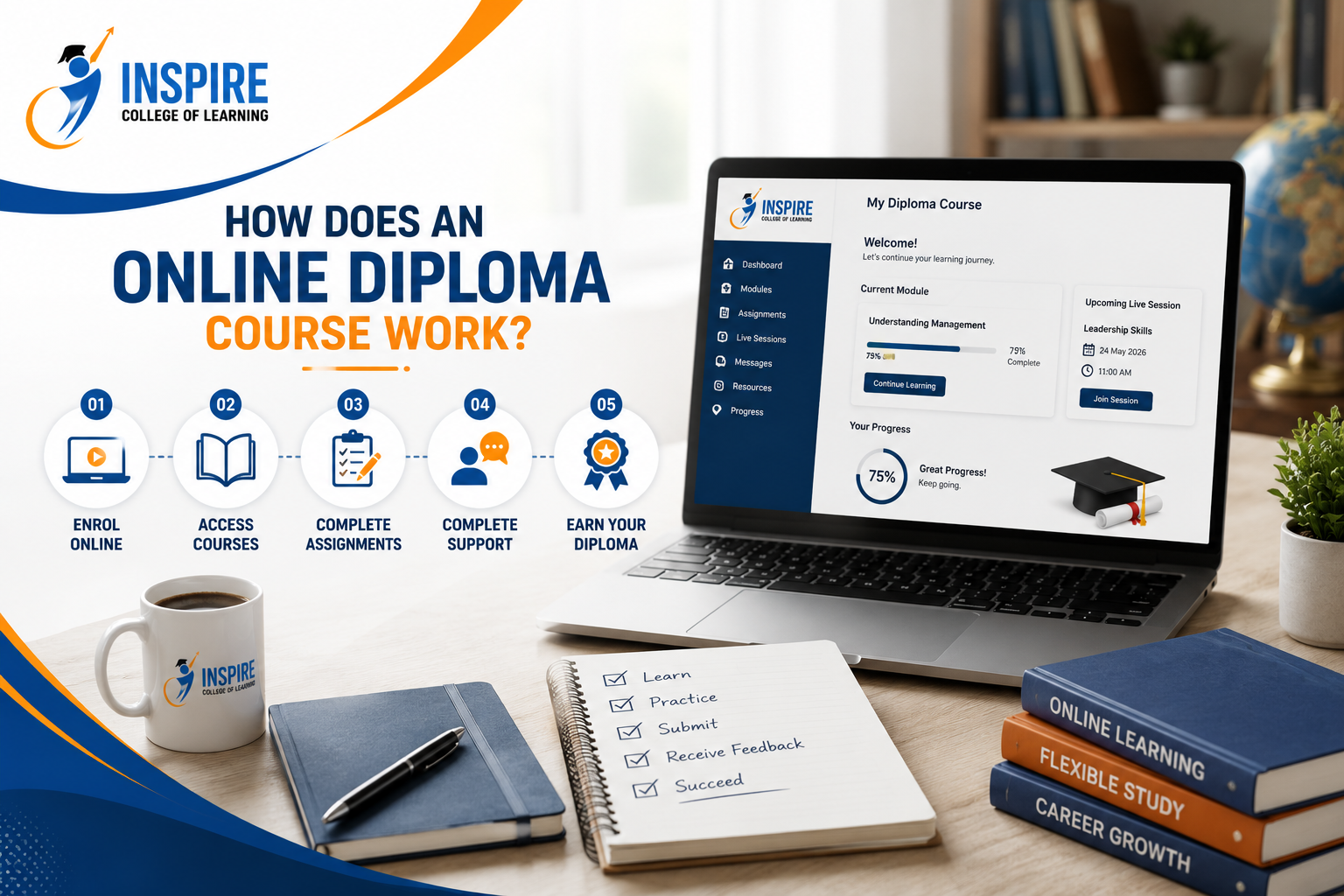
How Does an Online Diploma Course Work?
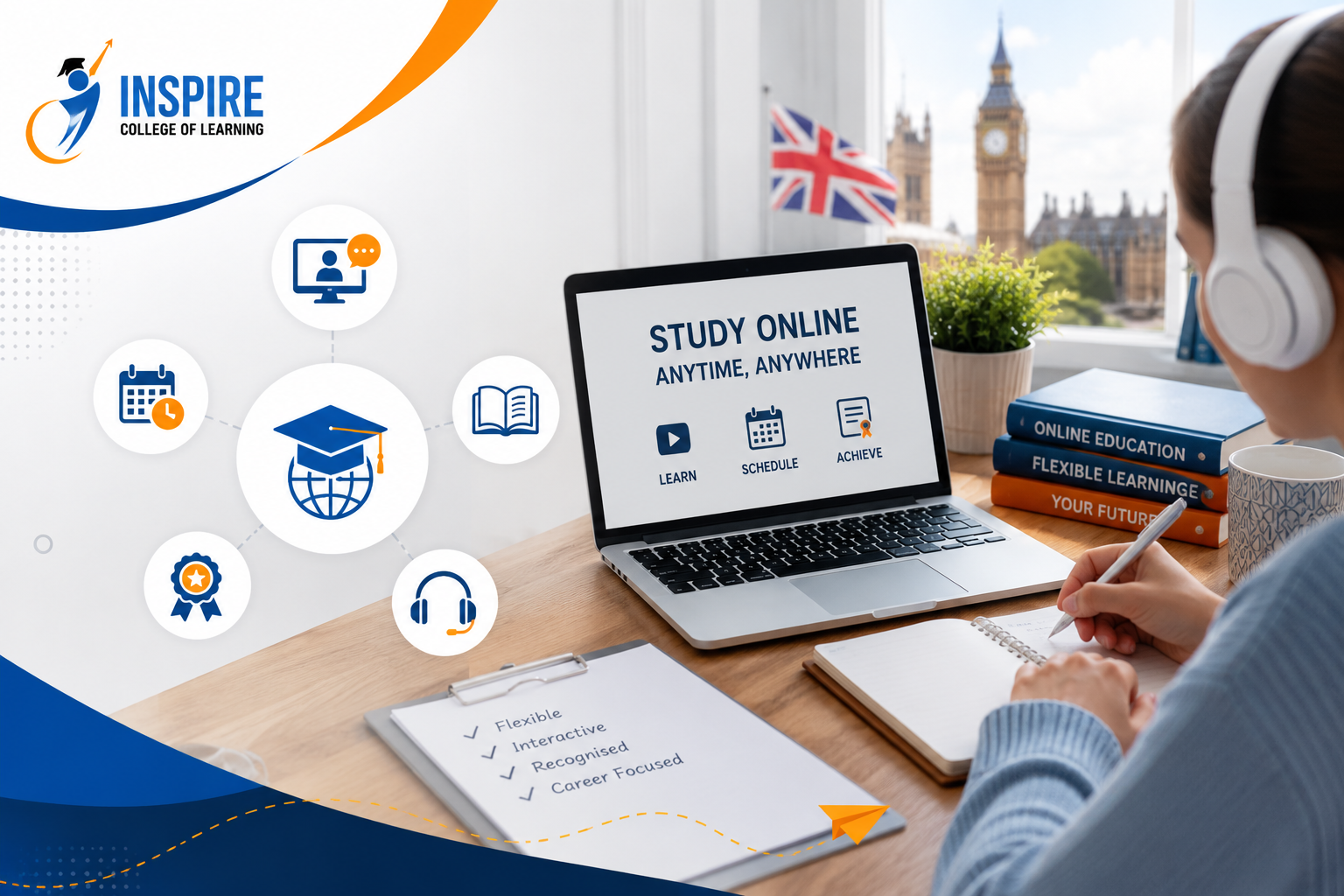
An online diploma normally allows you to access teaching materials, assignments and academic support through a digital learning platform rather than attending regular classroom sessions.
Depending on the provider and qualification, the learning experience may include:
-
online study materials;
-
recorded lectures or presentations;
-
reading and case studies;
-
assignment briefs;
-
tutor guidance;
-
online discussions;
-
independent research;
-
project work;
-
digital submission of assessments; and
-
feedback through the learning platform.
The exact structure varies.
Some courses provide scheduled live teaching. Others rely more heavily on independent study with tutor support. Certain programmes are highly flexible, while others still have fixed submission dates and structured academic calendars.
This is why the phrase study at your own pace deserves a little care.
Flexibility does not always mean that a course can be left indefinitely and resumed whenever convenient. Registration periods, assignment deadlines and maximum completion times may still apply.
A better description is often: flexible, structured online learning.
Online Learning vs Distance Learning vs Blended Learning
These terms are often used together, but they do not always describe exactly the same arrangement.
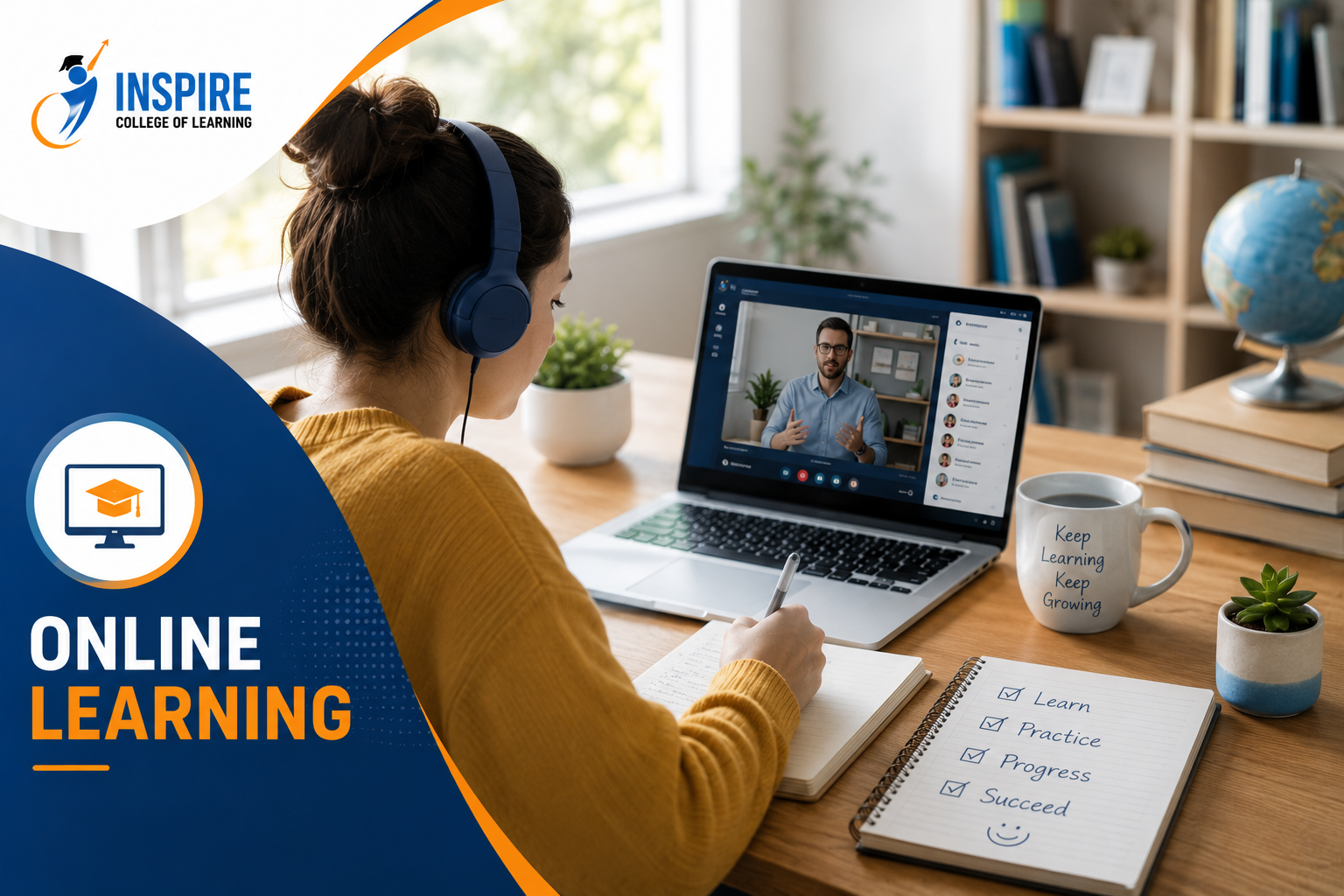
Online Learning
Online learning usually means that most or all teaching resources, communication and assessment activities are delivered digitally.
A person might access the learning platform from home, work or another location rather than travelling to a physical campus.
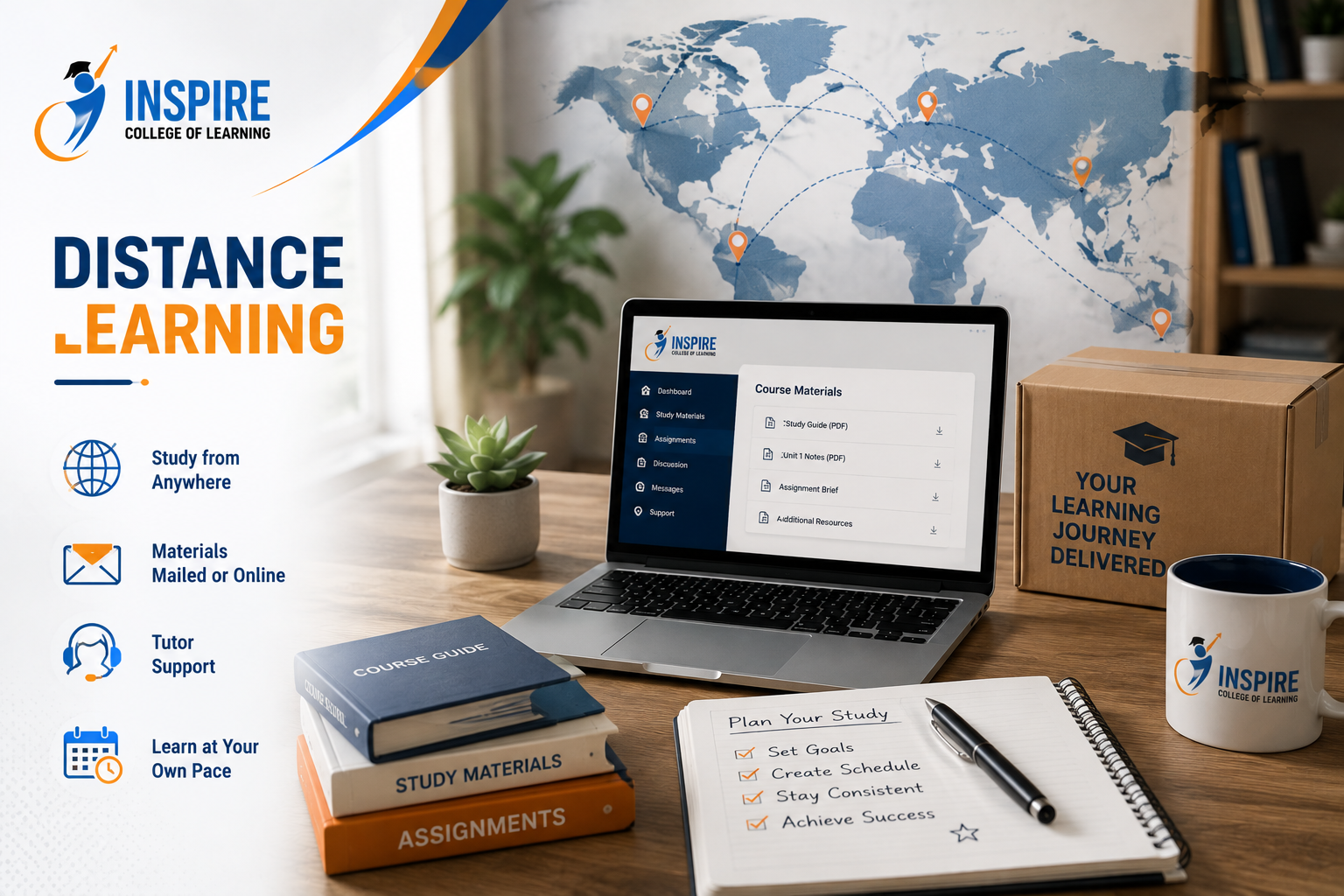
Distance Learning
Distance learning is the broader idea of studying remotely rather than regularly attending the education provider in person.
Modern distance learning is frequently delivered online, although the term existed long before digital learning platforms did.
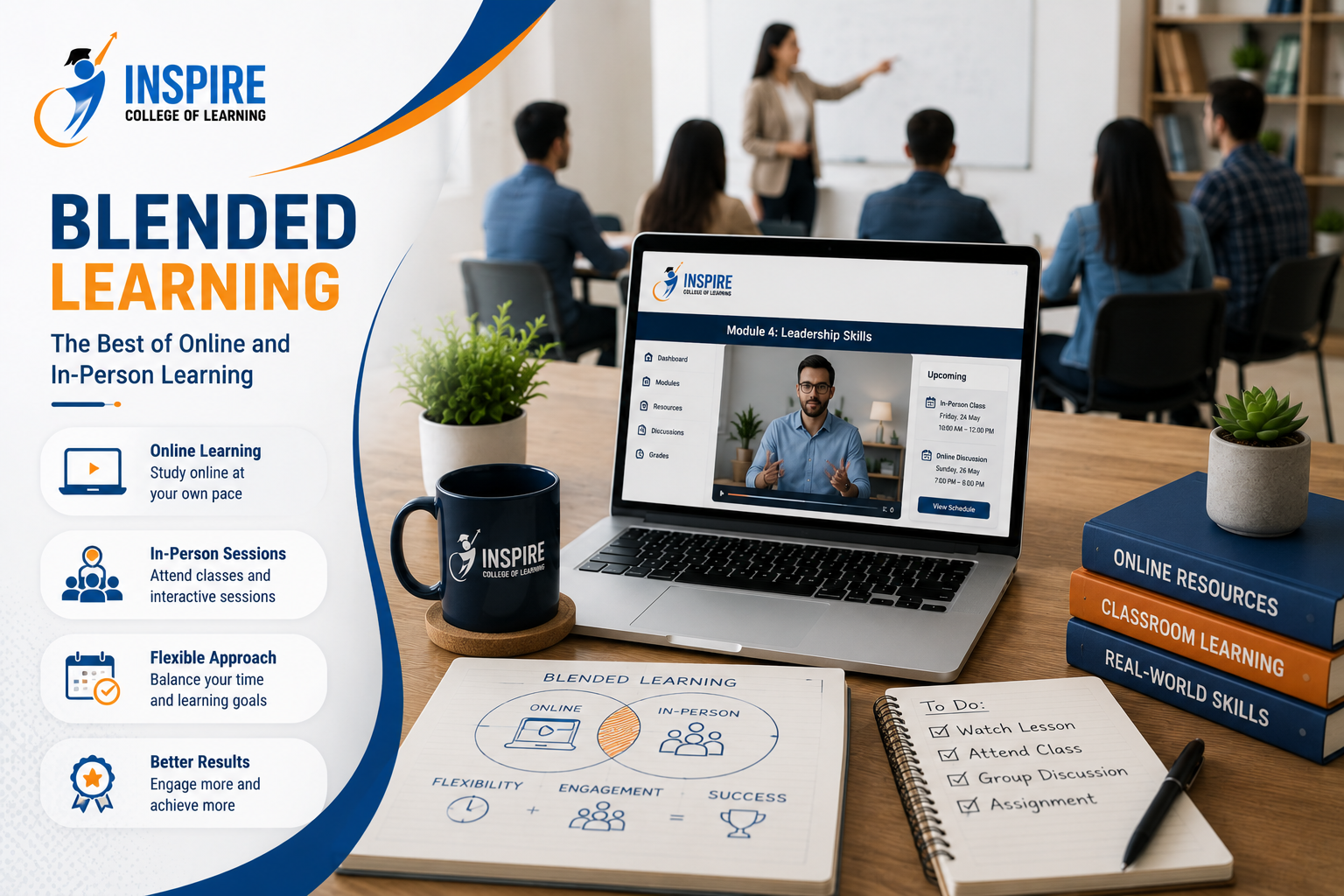
Blended Learning
Blended learning combines remote or online study with some face-to-face activity.
UCAS describes blended learning as combining in-person sessions with online study and notes that flexible approaches can help people balance education with employment and family commitments.
The difference matters because a programme advertised as online may still include a practical component, while a genuinely fully online programme may be completed without routine attendance.
Before enrolling, ask not merely:
“Is this course online?”
but:
“Is every part of this qualification, including assessment, possible to complete remotely?”
That question is considerably more useful.
Can Every Diploma Be Completed Fully Online?
No.
Some diploma qualifications can be delivered and assessed entirely online. Others cannot.
The deciding factor is usually not the subject name alone but the assessment requirements of the specific qualification.
A programme based mainly on:
-
written assignments;
-
research;
-
case studies;
-
projects; and
-
portfolios
may be relatively straightforward to deliver online.
A qualification requiring evidence of practical occupational competence may be different.
It might require:
-
observation in a workplace;
-
evidence from professional practice;
-
practical demonstration;
-
placement activity;
-
witness testimony;
-
supervised assessment; or
-
access to an appropriate working environment.
This can be particularly important when researching qualifications connected with adult care, vocational assessment, practical teaching or other competence-based work.
An education provider may deliver the academic materials online while still requiring certain evidence to come from the workplace.
So the honest answer to “Can I do my diploma completely online?” is:
Often, yes — but check the exact qualification before assuming that no practical or workplace activity is required.
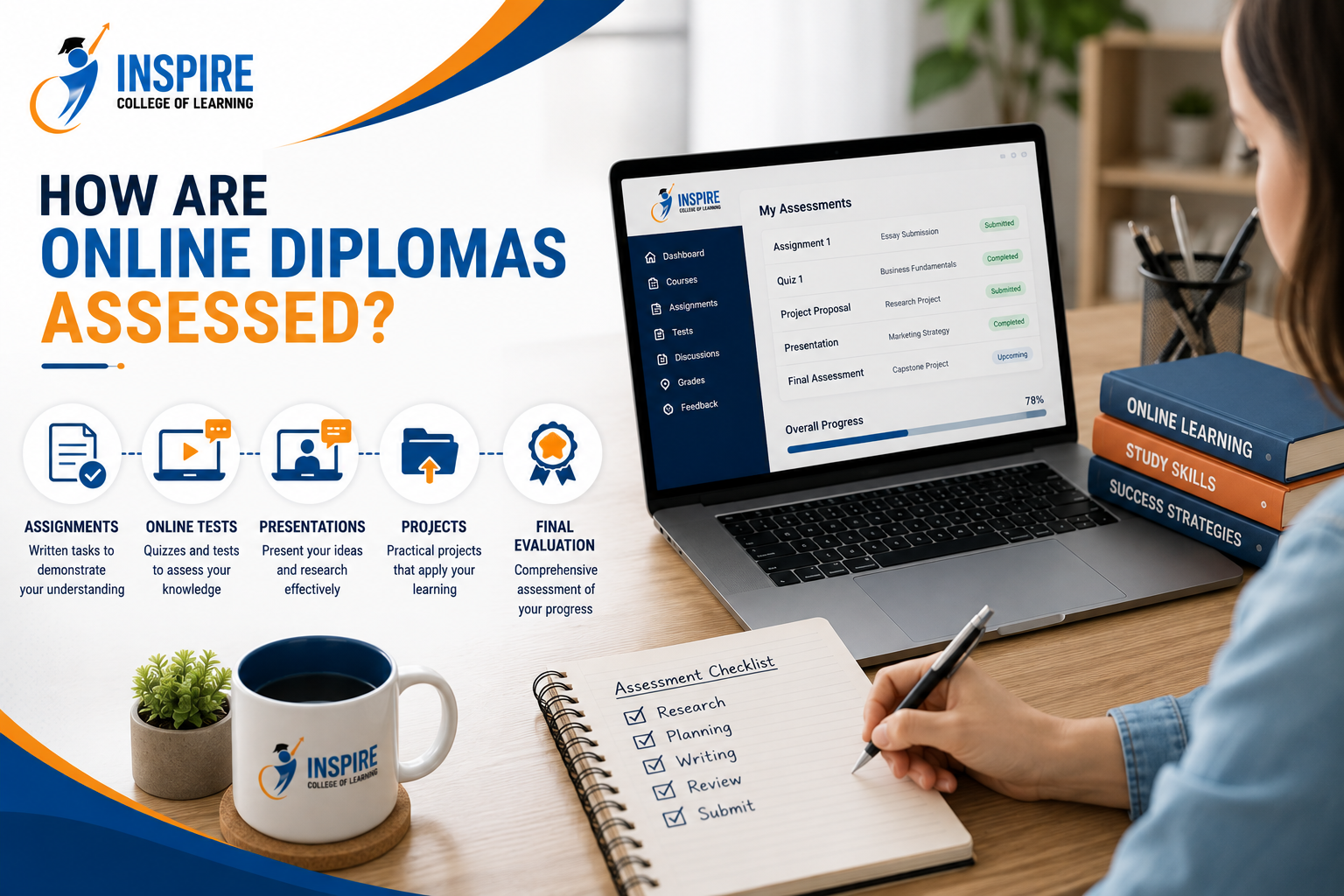
How Are Online Diplomas Assessed?
There is no single assessment method for all online diplomas.
Assessment depends on the qualification and awarding organisation.
Common methods can include:
Written Assignments
You may be given questions or tasks requiring research, explanation, analysis, evaluation or application of knowledge.
Reports and Case Studies
Professional subjects often require you to apply concepts to organisational situations or practical scenarios.
Projects
A longer project may assess your ability to investigate a subject, solve a problem or apply knowledge independently.
Portfolios
Some qualifications require a collection of evidence demonstrating learning or competence across several areas.
Presentations
You may need to prepare presentation materials, sometimes accompanied by notes or recorded delivery.
Online Examinations
Some qualifications may use examinations or other controlled assessments.
Workplace or Practical Evidence
Competence-based programmes may require observation, professional evidence or practical activities.
This is why statements such as:
“Online diplomas have no exams”
should be treated cautiously.
Some particular qualifications may be assignment-based, but that does not create a rule for every diploma in the UK.
Before enrolling, look for an assessment section on the individual programme page or ask the provider exactly how each unit will be assessed.
Are Online Diplomas Recognised in the UK?
An online diploma can be a recognised qualification, but recognition does not come from the fact that it is online.
That distinction is essential.
Consider these as separate questions:
How will I study?
Online, classroom, blended or workplace learning.
What qualification will I receive?
The formal qualification title and level.
Who awards it?
The awarding organisation.
Is it regulated where regulation applies?
This can be checked through the appropriate official register.
For England and Northern Ireland, GOV.UK's Register of Regulated Qualifications allows people to check whether a qualification is regulated, see detailed qualification information and compare similar qualifications.
So if recognition matters to you, do not judge a course from phrases such as:
-
online diploma;
-
accredited course;
-
internationally accepted;
-
professional certificate; or
-
career qualification
alone.
Look for the exact qualification.
A handsome course page cannot improve the status of a weak qualification, just as a modest website does not diminish a properly regulated one.
The qualification itself deserves inspection.
How Can I Check Whether an Online Diploma Is Genuine?
Before paying course fees, make a few practical checks.
1. Find the Full Qualification Title
Do not rely only on a shortened marketing name such as:
Business Diploma
Look for the complete qualification title.
2. Check the Awarding Organisation
The college teaching the course and the organisation awarding the qualification may be different.
Know both.
3. Check the Qualification Level
Make sure the level is appropriate for your existing education and experience.
If you need more help with the UK level system, see our guide to what level a diploma is in the UK.
4. Verify Regulation Where Applicable
For qualifications regulated in England and Northern Ireland, use the official GOV.UK Register of Regulated Qualifications. GOV.UK also directs people to the relevant qualification systems for Wales and Scotland.
5. Examine the Assessment Method
Find out whether assessment is:
-
assignment based;
-
examination based;
-
practical;
-
workplace based; or
-
a combination.
6. Check Entry Requirements
An advanced course is not automatically a better course.
If the entry criteria assume knowledge you do not possess, the qualification may be the wrong starting point.
7. Investigate Progression
If university or another qualification is your eventual destination, check whether the exact qualification is acceptable before enrolling.
A little verification at the beginning is considerably cheaper than disappointment at the end.
Is an Online Diploma the Same Qualification as a Classroom Diploma?
Sometimes the delivery method changes while the underlying qualification remains the same.
For example, an awarding organisation may approve a particular qualification that different providers deliver through different study arrangements.
What matters is whether the person studying online is actually registered for the same formal qualification.
Do not assume this merely because two course titles sound similar.
Compare:
-
full qualification title
-
qualification number where applicable
-
awarding organisation
-
level
-
credits or Total Qualification Time where relevant
-
units
-
assessment
-
final award
If those are different, the qualifications may also be different.
The internet is a classroom door, not a qualification framework.
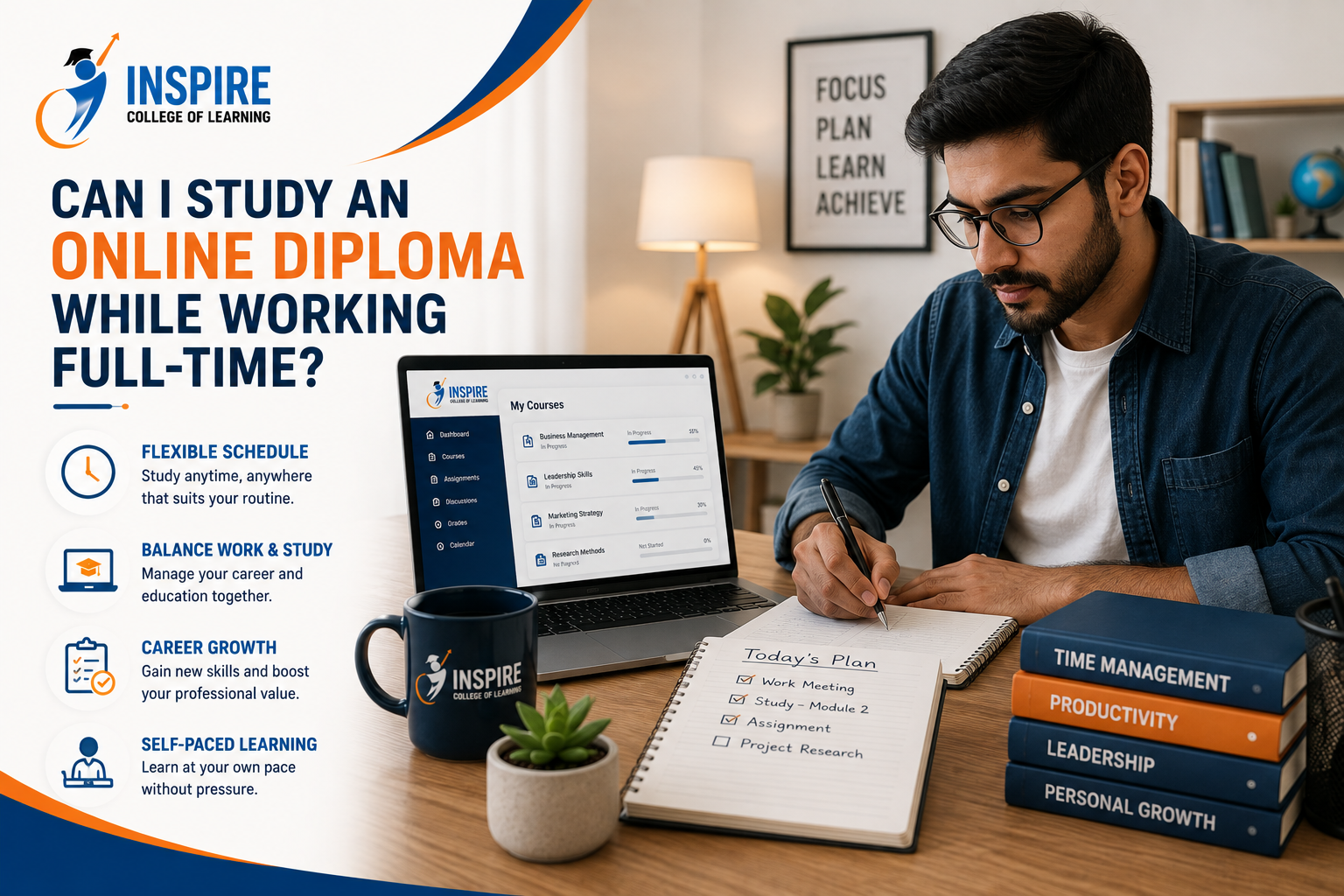
Can I Study an Online Diploma While Working Full-Time?
For many people, this is one of the chief reasons to study online.
Yes, it may be possible to complete an online diploma while working full-time, particularly when the course provides flexible access to learning materials and assessment is not tied to daily classroom attendance.
UCAS notes that flexible and distance-learning arrangements can help people combine study with employment and family responsibilities.
But flexibility should not be confused with having unlimited spare time.
Someone working full-time still needs to make room for:
-
reading
-
research
-
assignments
-
revision
-
tutor communication
-
projects
-
assessment deadlines
A useful routine often matters more than enthusiasm during the first week.
Two or three organised study periods each week can be more productive than repeatedly promising oneself that Sunday evening will somehow contain eight uninterrupted hours.
Before enrolling, ask yourself:
-
How many hours can I genuinely protect each week?
-
When do I concentrate best?
-
Do I have demanding periods at work?
-
Are there assignment deadlines?
-
Will family responsibilities affect my schedule?
-
Can I maintain this routine for several months?
Online learning can bend around life.
It cannot be expected to disappear into the cracks between everything else.
How Many Hours a Week Does an Online Diploma Require?
There is no single answer.
Weekly study time depends on:
-
qualification size
-
Total Qualification Time
-
number of units
-
course duration
-
assessment requirements
-
existing subject knowledge
-
individual study speed
Two people taking the same course may not require exactly the same number of hours.
Someone already working in business management may move more quickly through familiar concepts than someone meeting them for the first time.
Likewise, a person returning to education after many years may initially need more time for academic reading, research and assignment writing.
Instead of looking for a universal weekly number, ask the provider:
What is the qualification's expected study commitment, and how does that translate into the advertised course duration?
That gives you something useful to plan around.
How Long Does an Online Diploma Take?
Online Diploma courses do not all take the same amount of time.
Duration can depend on:
-
level;
-
qualification size;
-
study pace;
-
number of units;
-
assessment;
-
previous knowledge;
-
workplace requirements; and
-
the provider's delivery schedule.
A Level 3 qualification and a Level 7 qualification may have very different expectations.
Even two Diplomas at the same level can differ in size.
This is why the number of calendar months displayed on a course page should be considered alongside the qualification specification.
A short advertised duration does not necessarily mean an easy qualification. Nor is a longer course automatically more valuable.
What matters is whether the programme gives you a realistic amount of time to meet the required learning outcomes properly.
Which Diploma Levels Can Be Studied Online?
Online delivery can be found across several qualification levels.
Inspire College of Learning, for example, currently lists online professional qualifications across multiple levels and subjects, including programmes at Levels 3, 4, 5, 6 and 7, with individual pages explaining their delivery arrangements.
However, qualification level and delivery method are separate matters.
A Level 7 qualification is not automatically online.
A Level 3 qualification is not automatically classroom based.
The relevant questions are:
Is this particular qualification available online?
and:
Can all of its assessment requirements be completed through the proposed delivery model?
For a deeper explanation of the levels themselves, see What Level Is a Diploma in the UK?
What Diploma Subjects Can You Study Online?
Online professional study is available across a broad range of subjects.
At Inspire College of Learning, current programme areas include:
-
Business Management
-
Health and Social Care Management
-
Adult Care
-
Cyber Security
-
Information Technology
-
Data Science
-
Law
-
Education and Training
-
Psychology
-
Child Care
-
Tourism and Hospitality Management
-
other professional fields
The subject should not be chosen simply because it happens to be available online.
Begin with the career or further-study goal.
Then choose the delivery method.
If you are still deciding between subjects, see our guide to which diploma course is best for your career in the UK.
Can an Online Diploma Lead to University?
Some online Diploma qualifications may support progression to university or higher-level study.
But the fact that a qualification was studied online does not, by itself, determine progression.
Universities can consider matters such as:
-
exact qualification title
-
awarding organisation
-
level
-
credits
-
subject
-
grades
-
previous study
-
their own admissions or credit-recognition policies
A Diploma studied online may therefore be acceptable where the receiving university recognises that qualification.
Another Diploma at the same level may not provide exactly the same progression route.
If university is your destination, begin there.
Find the programme you eventually want to enter and ask what qualifications it accepts.
Education is easier to navigate when the destination is chosen before the road.
Can International Applicants Study a UK Diploma Online?
Often, yes.
One of the obvious advantages of online education is that a person does not necessarily need to live near the provider in order to access teaching materials and academic support.
International applicants should nevertheless make several additional checks.
Entry Requirements
Make sure previous qualifications satisfy the programme's requirements.
English Language Ability
Advanced study can require substantial reading and academic writing, even when a separate language test is not required for every programme.
Assessment Requirements
If workplace evidence or observation is required, confirm whether it can be completed in your country.
Recognition
Check how the qualification will be treated by:
-
employers
-
universities
-
professional bodies
-
regulators
-
government authorities
where you intend to use it.
Time Zones
If the course contains live sessions, check whether they are practical from your location.
Progression
If you intend to use the Diploma for university admission overseas, ask the receiving institution about the exact qualification.
Most importantly, studying a UK qualification online from another country should not be confused with physically studying in the UK.
Online enrolment does not by itself provide a UK student visa, immigration status or right to work in the UK.
Those are separate legal matters with their own requirements.
Are Online Diplomas Recognised by Employers?
Employers decide which qualifications they accept.
Some jobs ask for a particular qualification level. Others ask for a specific degree, professional registration, technical certification or licence. Many place substantial weight on experience and practical ability as well as formal education.
For that reason, there is no responsible way to say:
“Every employer accepts every online Diploma.”
A better question is:
Does this exact qualification meet the requirements of the work I intend to pursue?
Check:
-
job descriptions
-
employer requirements
-
professional standards
-
regulatory requirements
-
practical skills
-
experience expected
Where an occupation is regulated, always investigate the formal professional route.
A related Diploma may develop useful knowledge without granting professional registration.
Do Online Diplomas Have Exams?
Some do. Some do not.
Many professional Diploma programmes are assessed through assignments, projects or portfolios, but assessment varies between qualifications.
Inspire currently describes several of its online professional qualifications as using assignments, projects and portfolios submitted through its learning system.
That should not be turned into a claim about every Diploma on the market — or even every qualification in the same subject.
Always check the individual course.
If avoiding examinations is important to you, ask directly:
“What are the assessment methods for every unit in this qualification?”
The answer should be clearer than a general promise that the course is “flexible”.
What Equipment Do You Need to Study a Diploma Online?
Requirements differ, but most people will need:
-
a reliable computer or laptop
-
stable internet access
-
a modern web browser
-
word-processing software
-
the ability to read and create common document formats
-
access to email
-
the ability to upload assignments
-
somewhere reasonably quiet to study
Some programmes may also require:
-
a webcam
-
microphone
-
specialist software
-
spreadsheet software
-
programming tools
-
workplace access
-
subject-specific equipment
Technology should be checked before enrolment rather than after the first assignment appears.
What Are the Advantages of Studying a Diploma Online?
Online study can offer meaningful advantages when the qualification and person are well matched.
Greater Flexibility
Learning materials may be accessible outside conventional classroom hours.
Less Travel
Remote study can reduce commuting time and associated costs.
Ability to Remain in Employment
Many people can continue working while studying.
Wider Choice
Applicants are not restricted entirely to providers within commuting distance.
International Access
People outside the UK may be able to study UK professional qualifications remotely, subject to programme requirements.
Development of Independent Learning
Online study requires organisation, research and self-management — skills that can be useful well beyond the qualification itself.
What Are the Disadvantages of Online Diploma Study?
There are trade-offs too.
You Need Self-Discipline
A classroom creates a timetable for you.
Online learning often asks you to create more of that structure yourself.
There May Be Less Face-to-Face Contact
Some people enjoy independent study. Others learn better through regular physical interaction.
Practical Requirements May Remain
An online learning platform cannot magically turn every workplace assessment into a written assignment.
Technology Matters
Poor internet access or inadequate equipment can become a persistent obstacle.
Flexible Does Not Mean Easy
A regulated or academically demanding qualification does not become less demanding because the reading is displayed on a screen.
That point is worth remembering.
Flexible is not the same as effortless.
What Should You Check Before Enrolling on an Online Diploma?
Before paying, work through this checklist.
The Qualification
-
What is the full title?
-
What level is it?
-
Who awards it?
-
Is it regulated where applicable?
The Delivery
-
Is it fully online or blended?
-
Are live sessions required?
-
Is learning asynchronous or scheduled?
The Assessment
-
Assignments?
-
Projects?
-
Exams?
-
Portfolios?
-
Workplace observation?
-
Practical evidence?
The Time Commitment
-
What is the expected study workload?
-
Are there fixed deadlines?
-
What is the maximum registration period?
The Entry Requirements
-
Do your qualifications meet them?
-
Is professional experience required?
The Progression
-
What can the qualification reasonably lead to?
-
Has university progression been confirmed by the receiving institution?
The Recognition
-
Will it meet the requirements of your intended employer, university, professional body or overseas authority?
An online course should survive these questions comfortably.
If the answers remain vague, keep asking.
Studying an Online Diploma with Inspire College of Learning
Inspire College of Learning offers a broad range of online professional qualifications across fields including Business Management, Health and Social Care, Cyber Security, IT, Data Science, Law, Education and other specialist areas. Its current programme pages describe online delivery through a virtual learning platform, with access to digital materials, tutor support and online assessment processes on various qualifications.
For example, current Business Management, Cyber Security and Health and Social Care programme pages describe features including:
-
online course delivery
-
24/7 access to study resources
-
tutor guidance
-
independent study
-
assignment feedback
-
digital submission of assignments, projects or portfolios
Applicants should still read the individual programme specification.
The important questions remain the same:
What qualification am I studying?
Who awards it?
How will I be assessed?
What level is appropriate for me?
Where do I intend to go afterwards?
Technology makes education easier to reach.
Judgement is still required to choose it well.
So, Can I Do a Diploma Course Online?
Yes. Many Diploma courses can be studied online, including professional qualifications across business, care, technology, law, education and other subjects.
But the word online should never be the end of your research.
Before enrolling, check:
-
the exact qualification
-
awarding organisation
-
level
-
regulatory status where applicable
-
assessment
-
practical or workplace requirements
-
study commitment
-
progression opportunities
Some programmes can be completed fully online. Others may still require evidence from a workplace or practical setting.
The best online Diploma is therefore not simply the one that can be opened on a laptop at any hour of the day.
It is the one whose qualification, delivery method and destination all make sense together.
Convenience can make education possible.
A well-chosen qualification is what makes that convenience worthwhile.
Frequently Asked Questions
Q1. Can I do a diploma course online in the UK?
Yes. Many Diploma qualifications are available through online study. Whether a programme can be completed entirely remotely depends on its assessment and practical requirements.
Q2. Can a diploma be completed entirely online?
Some can. Qualifications assessed through assignments, projects and portfolios may be suitable for fully online study. Others can require workplace evidence, observations, practical assessments or placements.
Q3. Are online diplomas recognised in the UK?
An online Diploma can be a recognised qualification. Recognition depends on the exact qualification and awarding organisation rather than simply on whether teaching is online. Regulated qualifications in England and Northern Ireland can be checked through the GOV.UK Register of Regulated Qualifications.
Q4. How can I check whether an online Diploma is regulated?
Find the full qualification title and awarding organisation, then search the relevant official qualification register. GOV.UK provides the Register of Regulated Qualifications for England and Northern Ireland and directs users to the relevant systems for Wales and Scotland.
Q5. Can I study an online Diploma while working full-time?
Often, yes. Flexible online learning can make it easier to combine education with employment, but you still need sufficient time for study, assignments and deadlines.
Q6. How long does an online Diploma take?
There is no universal duration. It depends on the qualification level, size, assessment, delivery structure and study pace.
Q7. How many hours a week should I study?
Weekly study requirements vary between qualifications and individuals. Check the qualification's expected workload and course duration rather than relying on a universal number.
Q8. Do online Diplomas have exams?
Some may. Others are assessed through assignments, projects, portfolios or practical evidence. Always check the assessment requirements of the exact qualification.
Q9. Do online Health and Social Care Diplomas require workplace experience?
Some care-related or competence-based qualifications may require workplace evidence or practical assessment, while others may be knowledge-based and suitable for online assessment. Check the specific qualification rather than assuming that all Health and Social Care Diplomas have the same requirements.
Q10. Can international applicants study a UK Diploma online?
Often, yes, subject to the qualification's entry, assessment and practical requirements. International applicants should also check how the qualification will be recognised in the country where they intend to use it.
Q11. Does studying a UK Diploma online give me a UK student visa?
No. Studying a UK qualification remotely does not by itself provide immigration status, a student visa or the right to work in the UK.
Q12. Can an online Diploma lead to university?
Some can support progression to university or higher-level study. Acceptance depends on the exact qualification and the receiving institution's admissions and credit-recognition policies.
Q13. Is an online Diploma easier than classroom study?
Not necessarily. Online learning can be more flexible, but the qualification's learning outcomes and assessment still need to be completed. It also requires independent study, organisation and time management.